Using the Theory of Planned Behaviour in development communication
The Theory of Planned Behaviour helps explain why knowledge alone rarely changes action. This analysis examines how attitudes, social norms and perceived control interact with culture, power, agency and access to resources.
A Framework for decolonizing Strategic Communication in Devpt & Humanitarian Contexts
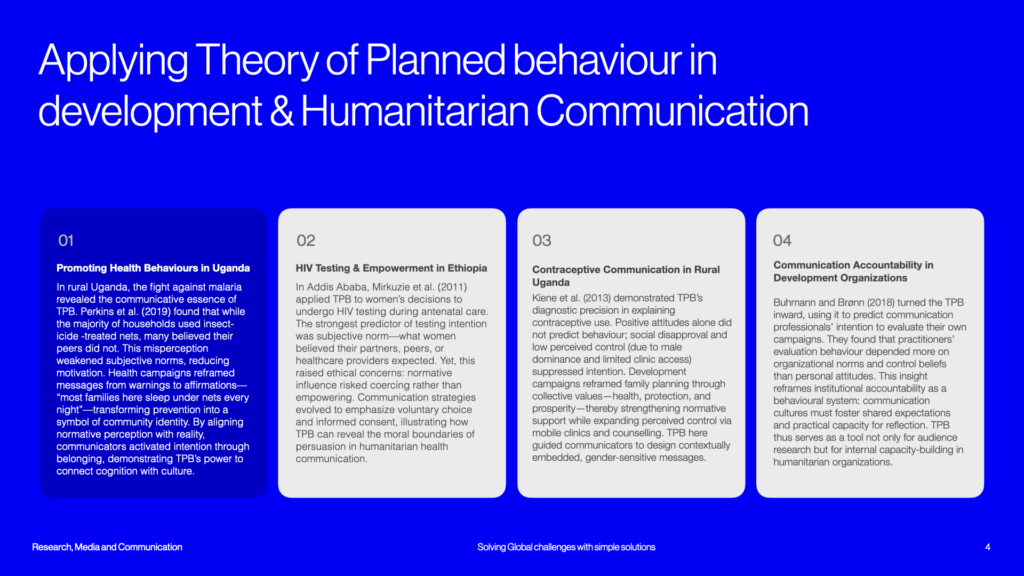
Why Knowledge Alone Does Not Change Behaviour
Why does knowledge so often fail to produce sustained action? From malaria prevention to environmental responsibility, awareness alone rarely changes behaviour. This chapter re-examines the Theory of Planned Behaviour (TPB) through the realities of development and humanitarian communication. Drawing on examples from Uganda, Ethiopia, China and Ecuador, it shows how attitudes, social norms and perceived control are shaped by culture, power, inequality and access to resources.
The key insight:
- Attitudes express perceived value.
- Norms reflect identity and belonging.
- Perceived behavioural control depends on agency and opportunity.
When communication overlooks these forces, structural barriers can be misread as individual resistance. A decolonised application of TPB moves beyond one-way persuasion towards participatory communication, community ownership and context-responsive action.
For communication strategists, programme teams and social-impact organisations, the practical lesson is clear: sustainable behaviour change emerges when people have not only the motivation to act, but also the social support, agency and enabling conditions to do so.
Publication · PDF
Chapter 1: The Theory of Planned Behaviour
Read the complete chapter or save a copy for reference.